

CRX4 Row Mount In-Row Cooling | UPS Solutions
Since 2002 • 100,000+ UPS units supported • 24/7 support
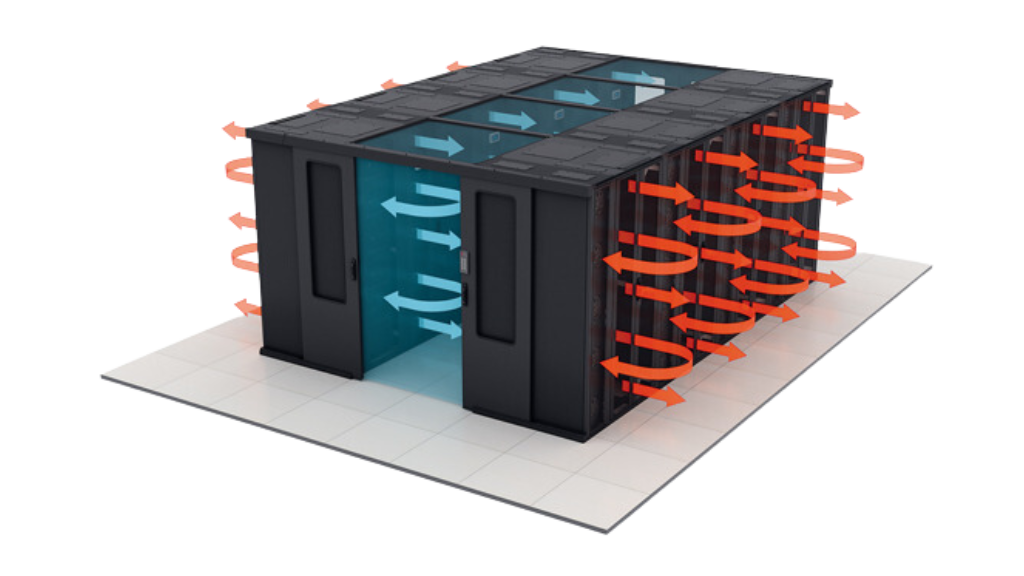
Close-Coupled Precision Cooling That Sits In the Rack Row
15 Sizes From 5.6 kW a Unit, Direct Expansion or Chilled Water
An in-row unit takes a position in the row, between the cabinets. It draws hot air straight out of the hot aisle and discharges cold air into the cold aisle, so the air travels about a metre instead of the length of the room. Nothing mixes on the way, and the full capacity of the unit is sensible cooling, because IT exhaust carries almost no moisture to remove.
That short air path is where the efficiency comes from, and it is why in-row is normally the right answer above roughly 5 kW a rack and the standard choice for a contained aisle at any density. A perimeter unit has to push air across a room and rely on it arriving where the load actually is. An in-row unit is already there.
Capacities are per unit, and a row takes as many units as its heat load calls for, so the row length and the density decide the answer rather than the biggest cabinet in the table. Group control links up to 8 units so they share capacity and rotate standby duty between them.
Units are 2000 mm high, the same 42U as the cabinets beside them, 1100 mm deep, and 300, 600 or 900 mm wide depending on capacity. No raised floor is required. They bolt into the row like another cabinet, which is what makes in-row the easiest platform in the range to add capacity to later.
Need a row sized, or density added to one you already have?
- Free heat load assessment
- Unit count and row layout
- DX or chilled water sizing
- Install, commission & 24/7 support
CRX4 Row Mount at a glance
- Direct expansion sizes12, from 5.6 kW
- Chilled water sizes3, to 93.2 kW a unit
- Sensible heat ratio100%
- Cabinet width300, 600 or 900 mm
- Height and depth2000 x 1100 mm
- Raised floor requiredNo
- Aisle containmentCompatible
- Service accessFront and rear
Not sure in-row is the right position?
Cooling sits where the heat is, and the row is one of ten positions in the CRX4 range. The cooling hub walks a server room from the perimeter to the processor and shows which platform belongs where.
Compare every cooling position →Three Ways to Put Cooling In the Row
The choice is decided by what the site already has to work with: somewhere outside for a condenser, a chilled water loop, or neither of the two.
Row Mount DX, split
An inverter compressor in the indoor unit, paired with a matched CRX4 condenser outdoors. The widest capacity span in the close-coupled range, and the usual answer wherever there is a wall, a roof or a plant deck to put the outdoor unit on.
- Twelve sizes, from 5.6 kW a unit
- Copper pipework, top or bottom entry
- Standard to minus 15 °C outdoor ambient
Row Mount CW, chilled water
Fed from a chiller or a central plant, with a motorised ball valve modulating capacity instead of a compressor. No refrigerant in the row, nothing to install outdoors, and capacity that rises as the water gets colder.
- Three sizes, to 93.2 kW a unit
- Rated at 7/12, 10/15 and 13/18 °C water
- Colour touchscreen, optional three-way valve
Row Mount packaged
The condenser is built into the unit, so there is no outdoor equipment and no refrigeration pipework to run. For edge cabinets, branch sites, factory floors and containerised rooms where there is nowhere to pipe to.
- 5.6 to 10.8 kW
- No outdoor unit, no refrigerant lines
- Rejects into the surrounding space
Inside a Cooling Row
In-row cooling is as much a layout decision as a product decision. This is what a contained row actually does with the air, and why the unit sitting between the cabinets outperforms the same capacity on the perimeter.
Swipe the diagram sideways to see all of it
Stage 1
Capacity goes in one position at a time. At around 5 kW a rack a single 300 mm unit can carry three or four cabinets, at 20 kW a rack it is closer to one unit for every two, and units added later share capacity and rotate standby duty with the ones already there. That is why in-row suits a room that is going to get denser rather than one that is finished.
CRX4 Row Mount Technical Data
Fifteen published sizes across direct expansion and chilled water, from 5.6 kW a unit. Figures are per unit, and a row takes as many as its load needs. Every unit is 100 percent sensible, so the full nameplate capacity goes into cooling the IT load rather than removing moisture that was never there.
In-Row Precision Cooling
Capacity per unit. Inverter compressor on direct expansion, motorised ball valve on chilled water, EC fans on both.
Swipe the table sideways to see all of it
Above roughly 40 kW a rack, liquid takes over
Air is comfortable to around 20 kW a rack and can be pushed to roughly 40 kW with containment and close-coupled cooling. Past that the fan energy needed to move enough air starts to undo the benefit, and rear door, direct to chip or immersion is the better answer.
How Many Units a Row Needs, and Where They Sit
In-row is a layout decision as much as a product decision. These are the four things that decide the unit count, and they are worth settling before anything is ordered.
One unit per two to four cabinets
At 5 kW a rack, a single 300 mm unit can carry three or four cabinets. At 20 kW a rack it is closer to one unit for every two. The ratio falls out of the heat load, the cabinet pitch and the width you can give up in the row, and it is the first number we work out.
Containment is what makes the numbers hold
Without it, hot exhaust finds a way back round to the cold aisle and the unit cools air it has already cooled. With the aisle contained, air carries a rack comfortably to around 20 kW and can be pushed to roughly 40 kW.
Redundancy across the row, not per unit
Group control covers up to 8 units, sharing capacity and rotating standby duty so the spare is not ageing differently to the rest. Lose one unit in a row of five and the remaining four pick the load up.
Add capacity one position at a time
Density goes up in stages on most sites, and in-row goes in the same way, one 300, 600 or 900 mm position at a time with no plant upgrade and no raised floor. That is the main reason in-row suits a phased build.
What Comes Fitted, and What You Can Add
An in-row unit lives in the middle of a working row, so how it is serviced matters as much as what it is rated at. We specify the options against the site rather than selling a standard build.
Inverter compressor or modulating valve
On direct expansion an inverter compressor holds capacity against the load instead of cycling on and off. On chilled water a motorised ball valve does the same job, which also stops the water short cycling when the heat load drops away.
EC fans, quick-couple modules
Fans modulate airflow to what the IT equipment is actually drawing rather than running flat out. Each fan module comes out on quick-couple connections, so a fan change does not mean taking the unit off line.
Controller and BMS integration
A precision cooling controller monitors and protects the unit continuously and integrates with a building management system for site-wide display and control. Group control covers up to 8 units. Chilled water units add a colour touchscreen.
G4 filtration and sealed doors
An easy-change G4 element and sealed doors keep a micro data centre clean and quiet. The filter comes out from the front without tools, which matters when the unit is boxed in between two cabinets.
Built to be serviced in place
A slide-out drawer-style electrical box, front and rear access, and copper pipework that accepts top or bottom entry. Nothing on the unit needs side clearance, because in a row there is none to have.
Site and resilience options
Condensate pump, water leak detection, pipe extension kit for a long refrigerant run, dual power input, monitoring card, and a three-way water valve on chilled water. A low temperature kit extends outdoor operation well below the standard minus 15 °C.
Every split in-row unit needs a condenser outdoors
The outdoor side is CRX4 as well, matched to the indoor unit and commissioned with it. It is also where most of the running cost is decided, because this is the equipment fighting the Australian ambient. On a coastal site, specify the coil coating.
We Service the Brands You Already Run
The CRX4 range is vendor agnostic by design. It is built to work alongside the equipment already in your room, and our technicians look after the major precision cooling brands whether we supplied them or not.
Most rooms we walk into are already running something. We carry out preventive maintenance, filter and belt changes, refrigerant checks, control fault diagnosis and emergency response across Australia, New Zealand and the Pacific Islands, including on units well past their original support window.
When a room needs more capacity, CRX4 units are specified to sit alongside what is already installed, so cooling can be extended without disturbing equipment that is still doing its job.
Running something not listed here? Send us a photo of the nameplate and we will tell you how we can help.
Talk to a cooling specialistDesigned, Installed and Commissioned
Precision cooling is only worth what it does on site. This is a recent Australian deployment and the sequence every in-row project follows, from the first heat load calculation to the handover.
Western Sydney University
Two 40 kW in-row units holding 20 kW a rack under an AI supercomputer
Critical infrastructure behind a brain-scale AI supercomputer, deployed into a space with no raised floor, no anti-static flooring and no existing cooling. Two 40 kW CRX4 in-row units hold 20 kW a rack continuously under heavy computational load. It was delivered as a micro data centre, with redundant power and precision cooling specified and commissioned as one system. In-row is what makes a high density room possible in an ordinary building.
How an In-Row Project Runs
Assess
IT load a cabinet, row length, cabinet pitch and the design conditions the site actually sees.
Design
Unit count and positions, DX or chilled water, containment, redundancy and the matched condenser.
Supply
CRX4 row units and heat rejection, delivered as one package with the racks and power if needed.
Install
Units into the row, pipework, electrical, controls and containment.
Maintain
Commission under load, then 24/7 service for the life of the asset.

Why Choose UPS Solutions for In-Row Cooling
Australian owned critical power and cooling specialists. We design, supply, install, commission and maintain the whole row, indoor units and heat rejection together.
Unit count worked out properly
We size the row off the IT draw, the cabinet pitch and the redundancy target, then tell you how many positions you lose to cooling. If the honest answer is a different platform, we say so.
Power and cooling in one scope
In-row usually goes in alongside racks, PDU and UPS. We supply and commission the lot as one system, which is why a micro data centre arrives as a working room rather than a delivery.
Australian field team
Technicians in Sydney, Melbourne, Brisbane, Perth and Adelaide. The people who commission your row are the people who come back to service it.
24/7 support after handover
Preventive maintenance, filter changes, refrigerant checks, control faults and emergency response across Australia, New Zealand and the Pacific Islands.

Send us the IT load a cabinet and the row length
That is enough for us to work out the unit count, pick direct expansion or chilled water, size the heat rejection and put a configured price in front of you.
In-Row Cooling FAQs
The questions we are asked most often when sizing a row or adding density to one that already exists.
What is in-row cooling?
In-row cooling puts the air conditioning unit in the rack row itself, between the cabinets, instead of on the perimeter of the room. It draws hot air straight out of the hot aisle and discharges cold air into the cold aisle, so the air travels about a metre rather than the length of the hall. The short air path is where the efficiency comes from, and it means nothing mixes on the way. CRX4 row units start at 5.6 kW a unit across fifteen sizes, and a row takes as many units as its load needs.
How many in-row units does a row need?
It depends on the heat load a cabinet, not the number of cabinets. At around 5 kW a rack, one 300 mm unit can carry three or four cabinets. At 20 kW a rack it is closer to one unit for every two. The calculation uses the IT draw, the cabinet pitch, the redundancy target and how much width you can give up in the row. Send us those and we will work out the count.
Should I use in-row cooling or a perimeter CRAC?
Perimeter cooling suits a room with a modest and fairly even load, especially where there is a raised floor to discharge into. In-row suits a room where the load is concentrated, where density is above roughly 5 kW a rack, or where there is no floor void to use. Many halls run both, with perimeter units carrying the room and in-row units handling the high density rows.
In-row direct expansion or chilled water, which is right?
If the site has a chiller or a central chilled water loop, use chilled water. There is no refrigerant in the row, nothing to install outdoors, and capacity rises as the water temperature drops. If there is no chiller, direct expansion is the answer, with a matched CRX4 condenser outdoors. Where there is nowhere outside to put a condenser at all, a packaged unit carries its own and rejects into the surrounding space.
How much heat can in-row cooling handle per rack?
Air carries a rack comfortably to around 20 kW and can be pushed to roughly 40 kW with good containment and close-coupled cooling. Past that, the fan energy needed to move enough air starts to undo the benefit, and liquid cooling becomes the better platform. In-row is the close-coupled part of that equation, which is why it is the standard choice through the high density air range.
Do I need hot aisle containment with in-row cooling?
Not to make it work, but containment is what makes the capacity figures hold on site. Without it, hot exhaust finds its way back round to the cold aisle and the unit ends up cooling air it has already cooled. With the aisle contained, the unit sees the full return air temperature it was rated at, which is also why capacity rises as return air gets hotter.
Can in-row cooling be installed without a raised floor?
Yes, and that is one of the main reasons to choose it. The unit sits in the row at floor level, so there is no plenum, no perforated tiles and no floor void to build. We have delivered in-row into spaces with no raised floor, no anti-static flooring and no existing cooling at all.
What is a packaged in-row unit?
A packaged unit has the condenser built in, so there is no outdoor equipment and no refrigeration pipework to run. It rejects heat into the surrounding space rather than outside, which suits edge cabinets, branch sites, factory floors and containerised rooms where piping to an outdoor unit is not practical. Packaged in-row covers 5.6 to 10.8 kW.
Can I add in-row units later as density goes up?
Yes, and it is the usual pattern. Capacity goes in one 300, 600 or 900 mm position at a time, with no plant upgrade needed on direct expansion and no raised floor to modify. Group control covers up to 8 units, so units added later share capacity and rotate standby duty with the ones already there.
Do you service in-row cooling from other manufacturers?
Yes. Preventive maintenance, filter changes, refrigerant checks, control fault diagnosis and emergency response, on the major precision cooling brands as well as our own, across Australia, New Zealand and the Pacific Islands. CRX4 row units are also specified to work alongside equipment that is already installed, so capacity can be added to a row without disturbing what is already running.